
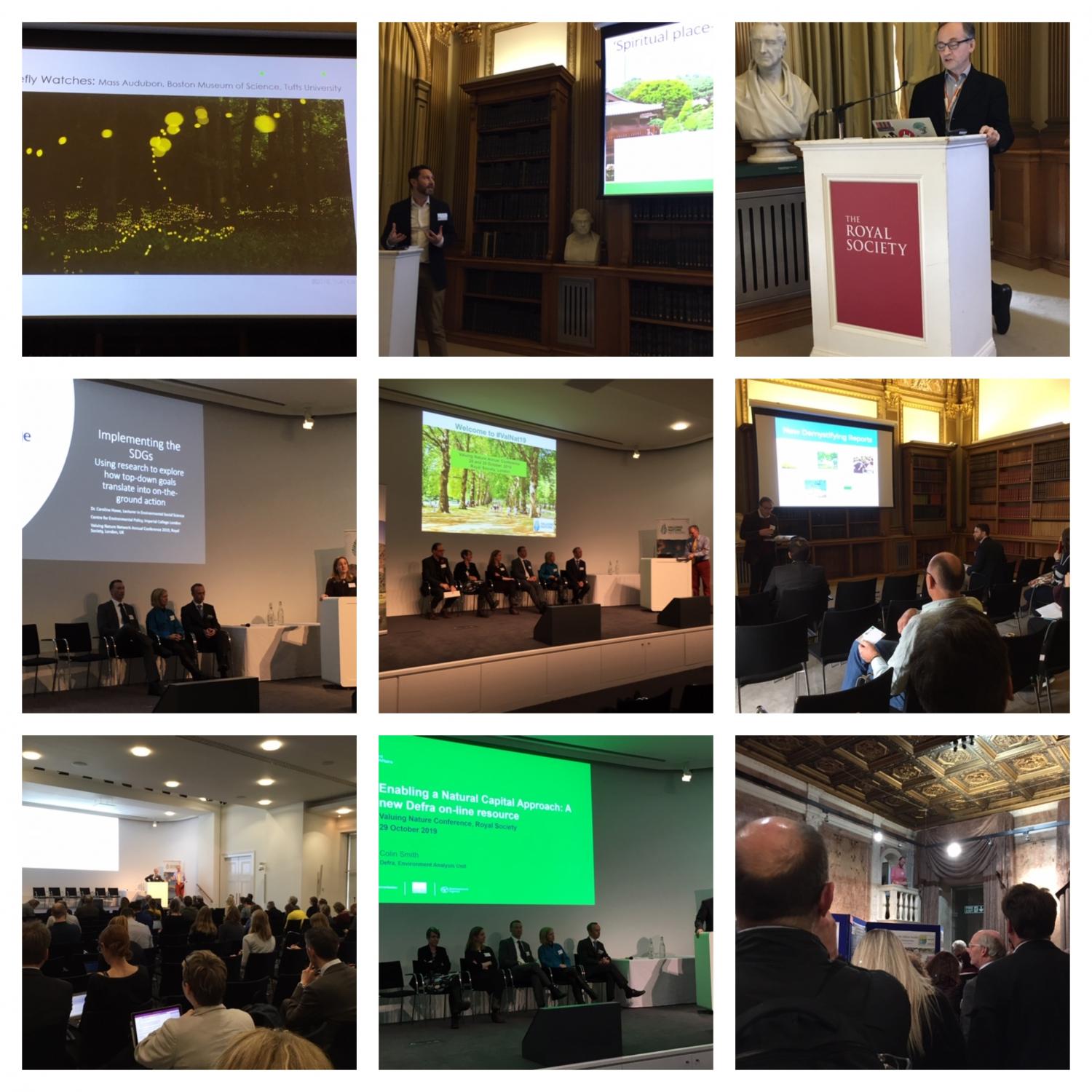
Day 1 - Monday 28 October
Session A:
The Long Road to London 2019 - Professor Dave Raffaelli
Valuing Nature and the Changing Landscape - Professor Rosie Hails
Challenges for the UK in a Post-CAP Policy Environment - Professor Sir Charles Godfrey
Session B:
A short introduction to the Landscape Decisions Programme – Professor Heiko Baltzer
Session C1: Valuing Nature in Changing Ecosystems
A framework linking ecosystem services and human well-being: an application to saltmarsh - Olivia Rendon, Plymouth Marine Laboratory (CoastWEB)
Psychological restoration potential of coastal environments: a photo-rating study - Elizabeth (Lizzi) Gabe-Thomas, Plymouth Marine Laboratory (CoastWEB)
“I want to show you something about the saltmarsh”: exploring intangible values for wellbeing as part of the CoastWEB project - Karen Henwood, Cardiff University (CoastWEB)

'English wetlands and mosquitoes: economic values, scenarios and risks?' - Joe Morris, Cranfield University (WetlandLIFE)
How can wetland creation and restoration be managed without risking nuisance and disease from mosquitoes? - Frances Hawkes, University of Greenwich (WetlandLIFE)
Session C2: Contributions of Urban Nature to Health and Wellbeing
Green infrastructure and the Health and wellbeing Influences on an Ageing population – headline findings - Sarah Lindley, University of Manchester (GHIA)
Reconnect dementia walks to nature - Philip James, University of Salford (GHIA)
To what extent might green infrastructure help to moderate ultra-fine particle concentrations in urban areas? - Matt Dennis, University of Manchester (GHIA)
Natural environments, health and wellbeing in Sheffield: population level associations - Anna Jorgensen, University of Sheffield (IWUN)
Identifying healthy green space interventions that work? Our tale of lists, valuations and barriers - Nicola Dempsey, University of Sheffield (IWUN)
The practice of everyday (wild)life - Julian Dobson, University of Sheffield (IWUN)
Session C3: Demystifying Tipping Points
Demystifying Tipping Points - Guy Duke, GD NatCap Ltd & Valuing Nature Programme Coordination Team
Tipping points in lowland agricultural landscapes - Stephen Watson, University of Portsmouth (TPAL)
Reconstructing land use change using historical data - Lucy Ridding, Centre for Ecology & Hydrology (TPAL)
Deriving dose response functions to help link ecological and economic approaches in peatlands - Laurence Jones, Centre for Ecology & Hydrology (Peatlands Tipping Points)
VNP Peatland Tipping Points project: social, economic and cultural aspects - Jasper Kenter, University of York (Peatlands Tipping Points)
Numerous abrupt changes in Great Britain vegetation carbon projected under climate change - Chris Boulton, University of Exeter (UK Ecosystem Benefits’ Tipping Points)
Abrupt shifts in national land use and food production after a climate tipping point - Paul Ritchie, University of Exeter (UK Ecosystem Benefits’ Tipping Points)
Session C4: The VN Cinema
LINK to the following films:
- "Immersed in Nature: a literature review of Virtual/Augmented Reality apps" (5min) - Kirk Woolford, Rougher Cut Productions
- "People Enjoying Nature (PEN): supported visits in the Pendle Hill landscape for people dealing with mental health and social isolation issues" (4min) - Cathy Hopley, Pendle Hill Landscape Partnership
- "Inspiring The Next Generation" (4min) - Toos van Noordwijk, Earthwatch
- "Improving Wellbeing through Urban Nature" (4min 50s) - Anna Jorgensen, University of Sheffield (IWUN)
- "The OWWL Model: Predicting wave and water levels to inform coastal safety" (6min 26s) - Dawn Scott, University of Exeter
Session D: Posters and exhibits
LINK to posters
LINK to Hide & Seek storytelling network
Day 2 - Tuesday 29 October
Session F1: Arts and Humanities Dimentions of Valuing Nature
A Room with A View: Observing nature and narrative through the bird hide - Victoria Leslie
The poetics of the science of place - Simon Read, Middlesex University London
Photoria: exploring the values of fireflies through immersive narrative - Kirk Woolford, Rougher Cut Productions
Spiritual place-making in urban landscapes - Christopher Ives, University of Nottingham
The funeral march of economic valuation - Chris Fremantle , Gray's School of Art
Session F2: Linking Natural Capital, Tipping Points and Ecosystem Services
Introduction - Mark Reed
Session F4: From Countryside to Coast - Planning the Landscape
Mapping natural capital in the Oxfordshire growth area - Alison Smith, University of Oxford
Barriers & enablers to aligning policy agendas – the case of Flood & Coastal Erosion Risk Management in Wales - Meghan Alexander, University of East Anglia
Natural Capital catchment register and accounts – trialling a natural capital approach within the environmental planning cycle - Kathrynne Moore, Environment Agency
Sustainable intensification in a post-Brexit landscape - Richard Gunton, University of Winchester
Future forests and ecosystem services: from theory to practice - Eleanor Tew, University of Cambridge, Forestry England
Session F5: Nature and the Wellbeing of Young People
The Role of Greenspace in Children’s Reward and Punishment Sensitivity - Eirini Flouri, University College London
The role of the physical environment in adolescent mental health - Marie Mueller, University College London
Tailoring Engagement with Urban Nature for University Students - Francesca Boyd, University of Sheffield
Out in the Open: An Examination of the Physical and Psychological Affordances of Outdoor Spaces within the delivery of Formal Therapy - Victoria White, University of Cumbria
Informing investment in the environment for health and wellbeing - Sian de Bell, University of Exeter
Session H1: Tools and Methods for Applying the Benefits of Urban Nature
Green Health Partnerships in Scotland - greening healthcare in Dundee - Rebecca Wade & Viola Marx , Abertay University & Dundee City Council/ NHS Tayside Public Health
Improving Access to the Natural Environment - Angela Hands, Public Health England
The value of Greater Manchester’s green infrastructure for addressing community needs - Helen Davies, WSP
Accounting for Diversity in the assessment of social and cultural values of urban nature - Kathrin Hörschelmann, Institute for Regional Geography Leipzig (IfL)
Exploring the needs, provision and value of GI for older people with the GHIA online tools - Gina Cavan, Manchester Metropolitan University
Creating liveable and sustainable places - Gemma Jerome & Katie Read, Building with Nature & Middlemarch Environmental Ltd
Session H2: Connecting People to Nature
‘I’m going to hug the tree’ Insights from a youth led intervention designed to facilitate a connection to nature with young people in a low SES area - Jenny Hallam & Laurel Gallagher
Differences in nature relatedness, pro-environmental attitudes and pro-environmental behaviours: The role of urban and nature place preferences - Stephanie Wilkie
The Systemic Impact of Community Gardening Activities on Wellbeing - Yvonne Black
Losing the Milky Way - Johanna Korndorfer
Session H3: Valuing Nature in Policy and Governance
Measuring and Driving progress towards the goals of the 25 Year Environment Plan - Robert Bradburne, Defra
The Dasgupta Review on the Economics of Biodiversity - Emily McKenzie, HM Treasury
Climate change reporting: Assessing outcomes and maximising outputs - Brendan Freeman, Committee on Climate Change
Implementing the SDGs: using research to explore how top-down goals translate into on-the-ground action - Caroline Howe, Imperial College London
Decisions, Values and Systems - Ruth Waters, Natural England
Enabling a Natural Capital Approach: A new Defra on-line resource - Colin Smith, Defra